✦ 7th CPC · 60% in force from 1 January 2026 · 63% confirmed for 1 July 2026 (order pending) · Data as of 8 October 2026

DA Calculator
Dearness Allowance Calculator 2026

Calculate your Dearness Allowance (DA) and total salary instantly on your basic pay for Central Government employees and pensioners under 7th Pay Commission rules.

60% In force from 1 Jan 2026
63% From 1 Jul 2026 (order pending)
~65% Projected from 1 Jan 2027
Verified against Department of Expenditure OM No. 1/1(i)/2026-E.II(B), dated 22 April 2026 · next revision due September–October 2026

DA Calculator – Calculate Dearness Allowance on Basic Pay

Enter your basic pay to calculate your exact Dearness Allowance, HRA and total monthly salary for any effective date from January 2016 onward, and download a PDF breakdown. Rates shown are correct as of 8 October 2026.

Enter your monthly basic pay as per 7th CPC Pay Matrix
Select an official DA rate or enter custom rate

Key Highlights & Latest DA Rates (2026)

  • 1 January 2026 — 60% DA (in force). Notified by the Union Cabinet on 18 April 2026 and by Department of Expenditure OM No. 1/1(i)/2026-E.II(B) dated 22 April 2026.
  • 1 July 2026 — 63% DA (+3 points), arithmetically confirmed. The 12-month AICPI-IW average for January–June 2026 closed at 151.9 on the Labour Bureau release of 31 July 2026, giving 63.75%, truncated to 63%. The formal Government order was still pending as of 8 October 2026.
  • 1 January 2027 — approximately 65%, projection only. AICPI-IW rose to 153.2 in July 2026 and 154.4 in August 2026, which moves the live 12-month average. Not official and not applicable to the July 2026 rate.
  • Arrears: A July 2026 revision is normally paid with three months of arrears — July, August and September 2026.
  • HRA reset (1 January 2024): DA crossed 50% then, revising HRA to 27% (X city metros), 18% (Y city) and 9% (Z city rural).
  • Next order expected: September–October 2026, with arrears for July, August and September 2026.

7th CPC Pay Matrix Salary Slabs & DA Table (2026)

Pre-calculated monthly Dearness Allowance across standard 7th Pay Commission levels comparing current active rate (60%) with projected July 2026 rate (63%).

7th CPC Pay Matrix Salary Slabs DA calculation table 2026
Pay Level & Grade Basic Pay (₹) Active DA @ 60% (₹) Expected DA @ 63% (₹) Monthly Hike (₹)
Level 1 (Entry / GP 1800)₹18,000₹10,800₹11,340+₹540
Level 2 (GP 1900)₹19,900₹11,940₹12,537+₹597
Level 3 (GP 2000)₹21,700₹13,020₹13,671+₹651
Level 4 (GP 2400)₹25,500₹15,300₹16,065+₹765
Level 5 (GP 2800)₹29,200₹17,520₹18,396+₹876
Level 6 (GP 4200 / Inspector)₹35,400₹21,240₹22,302+₹1,062
Level 7 (GP 4600 / Group B)₹44,900₹26,940₹28,287+₹1,347
Level 8 (GP 4800)₹47,600₹28,560₹29,988+₹1,428
Level 9 (GP 5400)₹53,100₹31,860₹33,453+₹1,593
Level 10 (GP 5400 / Officer)₹56,100₹33,660₹35,343+₹1,683
Level 11 (GP 6600)₹67,700₹40,620₹42,651+₹2,031
Level 12 (GP 7600)₹78,800₹47,280₹49,644+₹2,364
Level 13 (Director)₹1,23,100₹73,860₹77,553+₹3,693
Level 14 (Joint Secretary)₹1,44,200₹86,520₹90,846+₹4,326
Level 17 (Cabinet Secretary)₹2,25,000₹1,35,000₹1,41,750+₹6,750

7th Pay Commission DA Rate History (2016 – 2026)

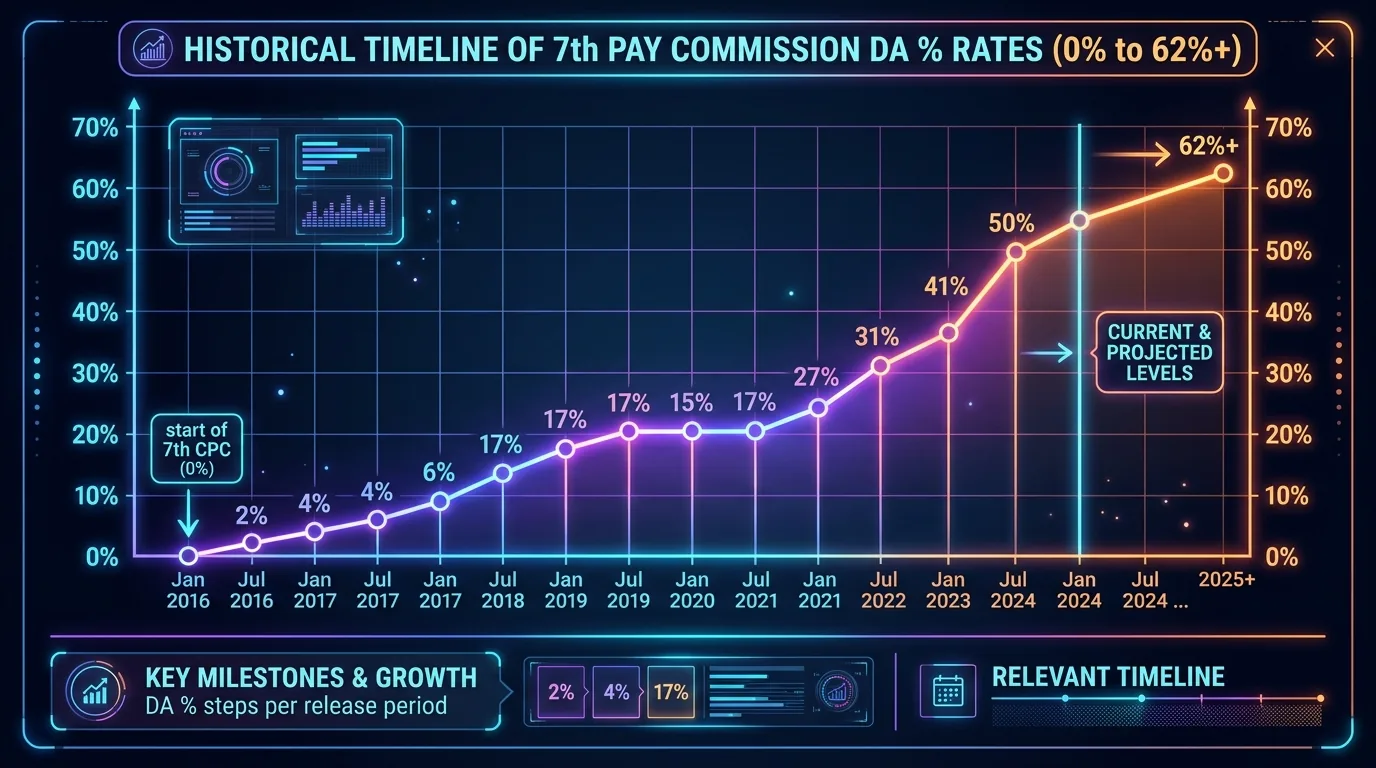
Historical timeline of every Dearness Allowance revision from January 2016 to the current period, with the effective date of each revision and its notification status. Data as of 8 October 2026.

7th Pay Commission DA Rate History Timeline 2016 to 2026 Chart
Historical DA Percentage Hike Timeline (2016 – 2026)
7th Pay Commission DA Rate Hike History Table
Effective Date DA Rate Hike Status
July 1, 202663%+3%Confirmed · order pending
January 1, 202660%+2%In force
July 1, 202558%+3%Past
January 1, 202555%+2%Past
July 1, 202453%+3%Past
January 1, 202450%+4%Past
July 1, 202346%+4%Past
January 1, 202342%+4%Past
July 1, 202238%+4%Past
January 1, 202234%+6%Past
July 1, 202128%RestoredRestored
Jan 2020 – Jun 2021DA Frozen (COVID-19 Pandemic)Frozen
January 1, 20160%Base7th CPC Start

How Dearness Allowance Is Calculated

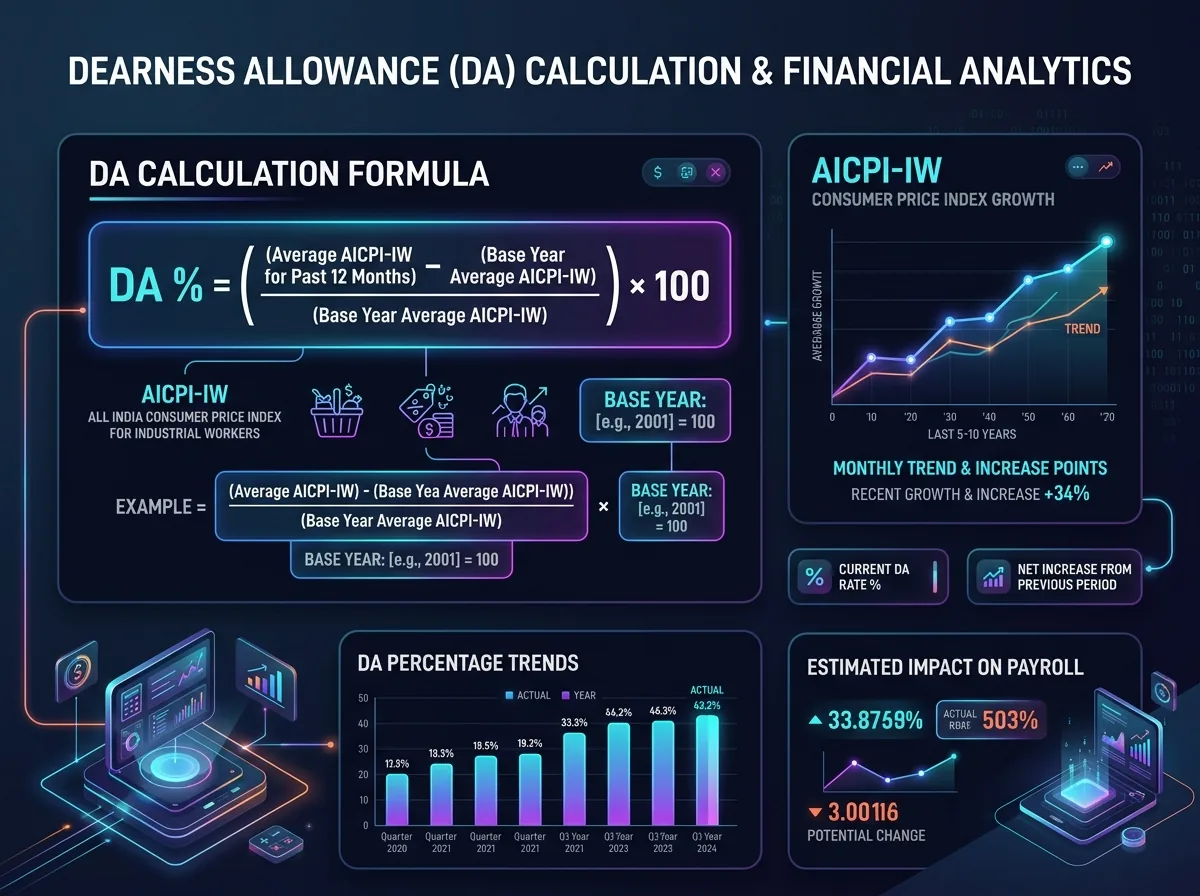
Official formula and methodology prescribed by the Ministry of Finance, Government of India under 7th CPC guidelines.

7th Pay Commission DA Calculation Formula Infographic Chart

1. DA Calculation Formula

DA Amount = Basic Pay × (DA Rate / 100)

Example Calculation: If your monthly Basic Pay is ₹56,100 (Level 10 Pay Matrix) and DA rate is 60%:

₹56,100 × 0.60 = ₹33,660 / month

When the expected DA rate of 63% is notified w.e.f. July 1, 2026:

₹56,100 × 0.63 = ₹35,343 / month (+₹1,683 hike)
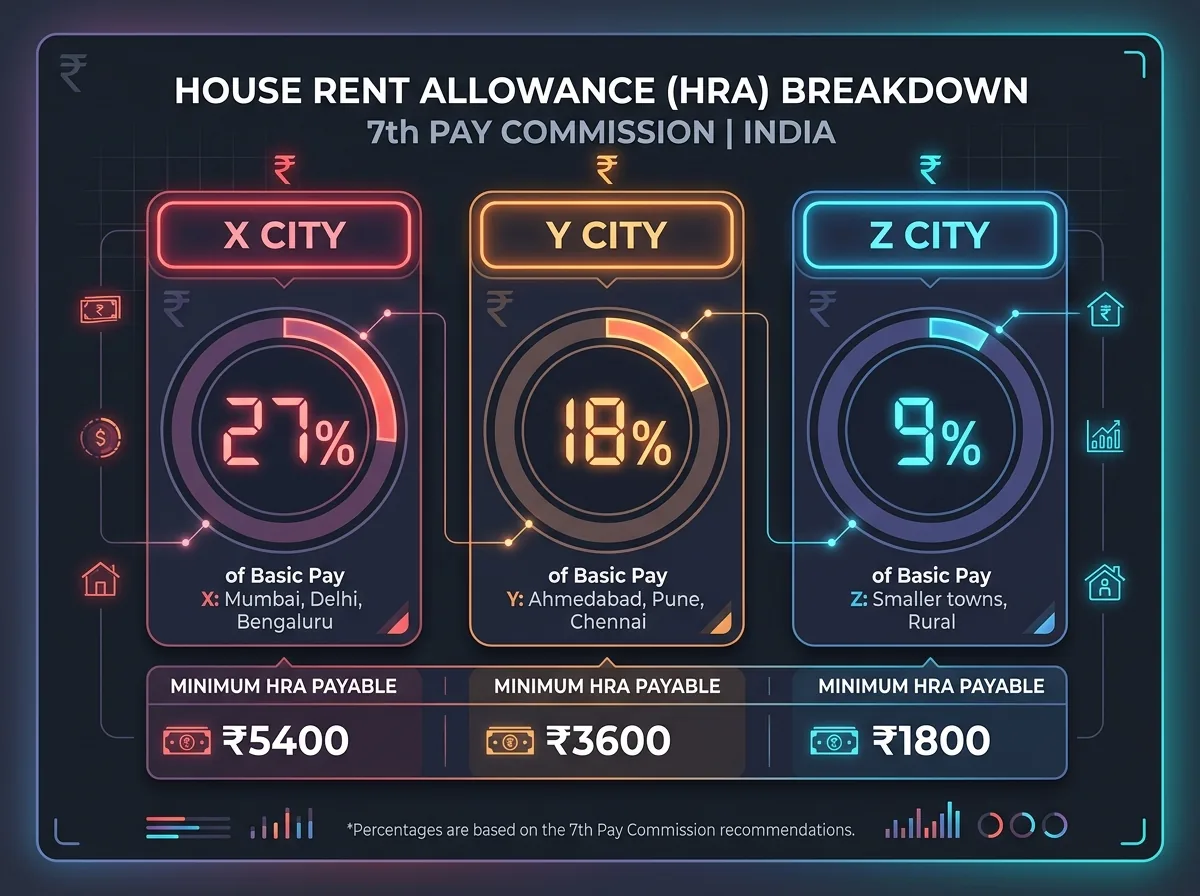
House Rent Allowance HRA City Classification X Y Z Rates Chart

2. Impact on HRA & Allowances

Since Dearness Allowance crossed 50%, House Rent Allowance (HRA) rates were revised upward:

  • X Cities (Metros): 27% of Basic Pay
  • Y Cities (Semi-Urban): 18% of Basic Pay
  • Z Cities (Rural): 9% of Basic Pay
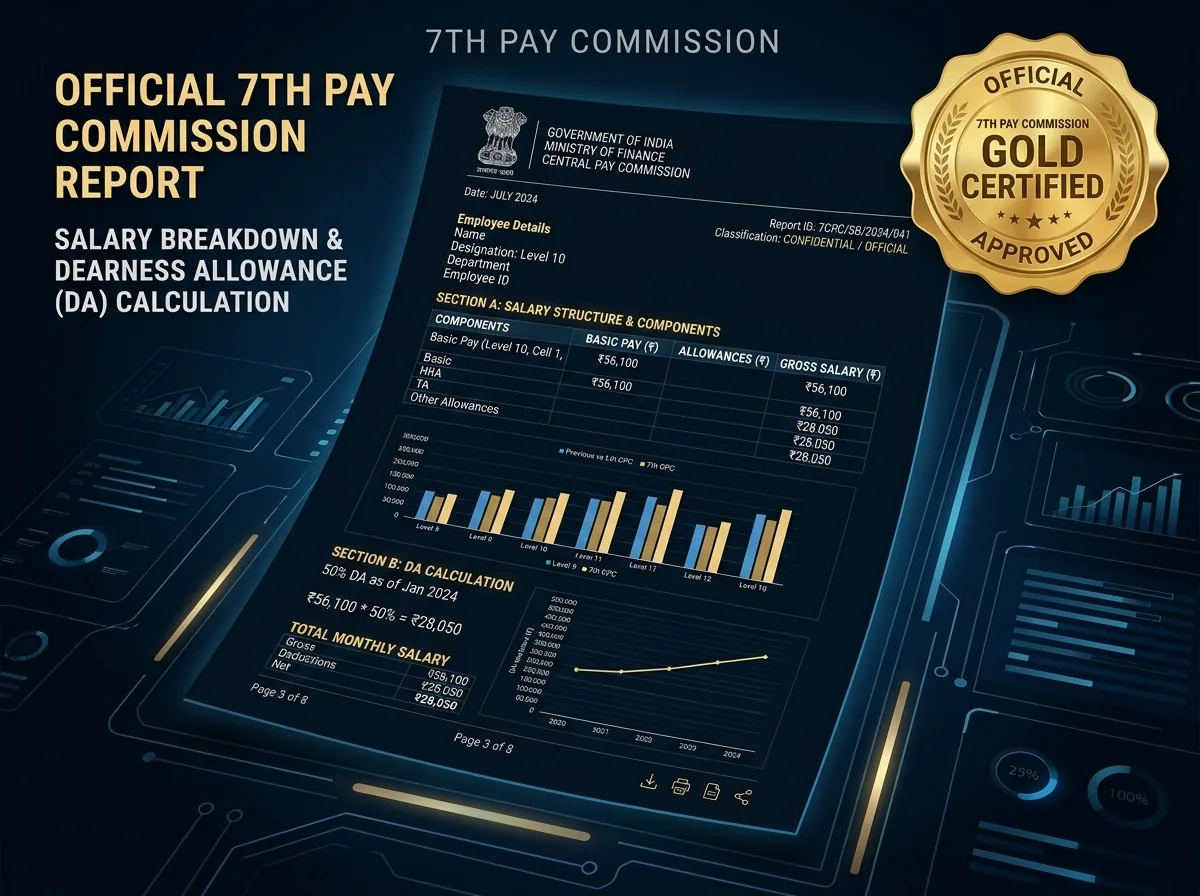
Official 7th CPC Salary and DA Breakdown PDF Report Sample

Key Terms & Definitions

Basic Pay
The base salary attached to a specific Pay Level in the 7th Central Pay Commission Pay Matrix, excluding all allowances, special pay, or HRA.
AICPI-IW
All India Consumer Price Index for Industrial Workers, published monthly by the Labour Bureau (Ministry of Labour & Employment), used to compute the inflation average for bi-annual DA hikes.
Dearness Relief (DR)
The inflation compensation allowance paid to Central Government pensioners and family pensioners, calculated at the exact same percentage rate as Dearness Allowance (DA).
7th Pay Commission (7th CPC)
The Central Pay Commission constituted by the Government of India to review and recommend the structure of pay, allowances, and pensions for civilian and defence personnel.

Frequently Asked Questions

Clear, authoritative answers regarding Dearness Allowance calculations, 7th CPC rules, taxation, and revisions.

What is the current DA rate for Central Government employees in 2026?

Answer: Three separate figures apply, each with a different date. 1 January 2026 — 60%, currently in force, notified by the Union Cabinet on 18 April 2026 and by Department of Expenditure OM No. 1/1(i)/2026-E.II(B) dated 22 April 2026. 1 July 2026 — 63%, a 3-point increase, arithmetically confirmed when the Labour Bureau released the June 2026 AICPI-IW reading of 151.9 on 31 July 2026, closing the calculation at 63.75%; only the formal Government order remained pending as of 8 October 2026. 1 January 2027 — approximately 65%, a projection only, reflecting the July 2026 (153.2) and August 2026 (154.4) index readings. That projection does not change the 63% already fixed for July 2026.

What is the expected DA hike from July 2026?

Answer: The July 2026 revision is a 3 percentage point increase, taking DA from 60% to 63% with retrospective effect from 1 July 2026. It is derived from the 12-month AICPI-IW average for January–June 2026, which closed at 151.9 and produced 63.75%; the Government truncates the decimal portion, giving a payable 63%. The calculation is final — what remains is the Government order, normally issued in September–October. Central Government employees and pensioners receive arrears for July, August and September 2026 once notified.

How is Dearness Allowance calculated using basic pay?

Answer: Dearness Allowance is calculated using the official formula: DA Amount = Basic Pay × (DA Rate / 100). For example, with a basic pay of ₹56,100 (Level 10) and a DA rate of 60%, the monthly DA is ₹33,660. At 63%, the monthly DA becomes ₹35,343.

Is Dearness Allowance taxable under Income Tax in India?

Answer: Yes, Dearness Allowance is 100% taxable under the Income Tax Act in India. It is treated as an integral component of salary income and added to gross taxable income under both the Old and New Tax Regimes.

When does the Government announce DA revisions?

Answer: DA revisions for Central Government employees and pensioners are declared bi-annually by the Union Cabinet of India: the January revision is typically approved in March/April, and the July revision is announced in September/October with retrospective arrears.

How does DA crossing 50% impact HRA and other allowances?

Answer: Under the 7th Pay Commission recommendations, when DA crossed 50%, House Rent Allowance (HRA) was revised upward to 27% (X Class metro cities), 18% (Y Class cities), and 9% (Z Class rural areas), alongside statutory revisions in gratuity ceiling and children education allowance.